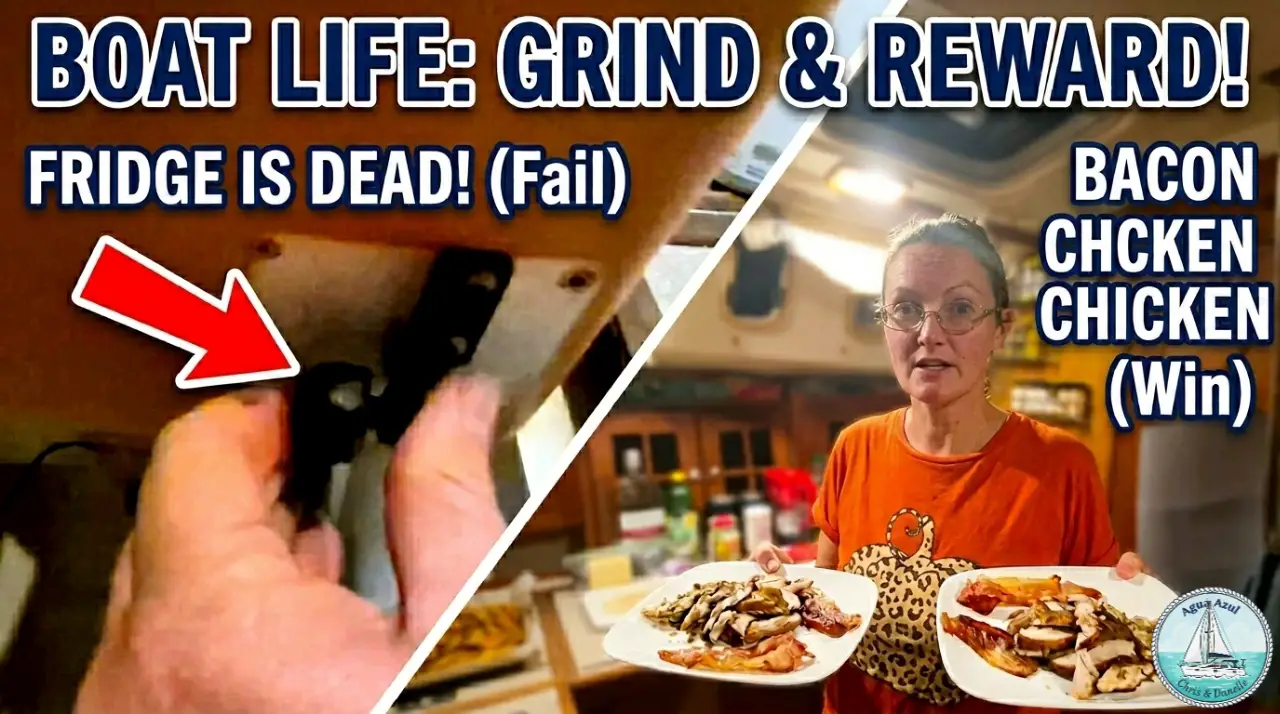
Sailboat repair & galley cooking might seem like worlds apart, but on a boat, they’re two sides of the same coin. We just finished battling some nasty storms—high winds, horizontal rain, and enough salt spray to coat everything we own. When the weather turns, things break. It’s a race against the clock to keep the boat functional before the next cell hits. This week, we’re tackling a “fail point” that’s been literally weighing us down: the hydraulic struts on the fridge.
The Grind: When the Hardware Quits
Living on a boat means you are the captain, the engineer, and the head of maintenance. The salt air is a silent killer for mechanical parts. If it moves, the salt wants to stop it.
I noticed our generator’s throttle was hanging up—a classic “fail point” for anyone running gear in the islands. Specifically, the throttle lever on the generator carburetor needed lube because the salt air creates just enough friction to make it stick. I hit it with some PB Blaster to get it moving again.
But the real kicker was the fridge. The hydraulic on the fridge failed, and let me tell you, when they go bad, they don’t just stop lifting—it felt like the hydraulic was holding the freezer closed. I had to force that lid up just to get to our stores. Having to manhandle a heavy fridge lid every time you want a cold drink is a recipe for a broken back.
Chris’s Tech Tip: When you replace your Hydraulic Lift Struts, make sure you look for the right length and lift force for your specific lid. Also, install them upside down. It keeps the internal seals lubricated and prevents moisture from settling in, which is the #1 reason they fail in a marine environment.
The Pivot: Consolidating and Prepping
We’re getting ready to head out and see family, which means we’re in “consolidation mode.” We’re clearing out the freezer and the pantry—because if you leave flour or open stores on a boat for too long, you’re just inviting a bug colony to move in.
While I was wrestling with hardware and chasing down a new leak in the guest cabin (nothing makes a guest feel more welcome than a wet pillow, right?), Danielle—my Babe—pivoted the mission to the galley. Since we’re clearing out the stores, it was time to break out the Crockpot and the secret weapons.
The Reward: Ho Maid Chef® Bacon Chicken Ranch Subs
There is nothing like a hot, toasted sub when it’s pouring outside. Danielle turned our cramped galley into a five-star bistro. We’re talking organic tomatoes fresh from the garden in town, onions, and that special kind of yum that only comes from thick-cut bacon.
The secret? Ho Maid Chef® Ranch Seasoning. She marinated that chicken until it was perfect, toasted the bread, and loaded it up. If you want to recreate this at home or on your own boat, check out our website and use our new search feature to find the right recipes for you. We might be soaked from a dinghy ride back from “Amsterdam,” but biting into that sandwich makes the grind worth it.
Technical Shop Gap
Need the same gear we use to keep the mission alive? Check these out:
- Hydraulic Lift Struts (Right length/force): https://amzn.to/4tL087W
- PB Blaster (For everything stuck): https://amzn.to/4t6doUv
- Crockpot (Galley Essential): https://amzn.to/4msw0vB
Check Out Past Travels
Travel FAQ
Q: How do you stop your boat from leaking during a tropical downpour?
A: The bottom line is constant vigilance and seal maintenance. We found a new leak during this storm because we left the hatches cracked for airflow. On a sailboat, if a seal is older than five years or if debris gets in the track, the water will find a way in.
Q: Is it hard to cook in a small boat galley during a storm?
A: It requires organization and a “one-pot” mentality. Danielle uses the Ho Maid Chef® approach, prepping ingredients like organic tomatoes and marinated chicken before the boat starts rocking too hard. A slow cooker is your best friend when the weather gets salty.
Q: What is the most common mechanical failure on a boat in salt water?
A: Corrosion of exposed wires and linkages is the primary culprit. My generator throttle hung up simply because of salt buildup on the wire. Regular application of a high-quality lubricant like PB Blaster can prevent a total engine fail point.
Q: Why do boat fridge hydraulics fail so often?
A: The internal seals dry out or corrode from the humid salt air. Replacing them is a 10-minute job if you have the spares. Always carry a set of universal gas struts; they are cheap insurance against a heavy lid slamming on your hand.
Video Time Chapters
- 00:00 – Intro: Storms and Boat Breakage
- 01:35 – Danielle’s Kitchen: The Reality of Cooking on a Boat
- 02:50 – Recipe: Bacon Chicken Ranch Hot Subs
- 04:17 – Unexpected Downpour and Organic Ingredients
- 06:00 – Maintenance: Generator and Refrigerator Hydraulics Repair
- 07:49 – Easter and Flooding in the Harbor
- 08:18 – Finding a New Leak on the Boat
- 09:12 – Dealing with Water Inside After the Rain
- 10:10 – Day 2: Slow Cooker Steak Sandwiches and Cabbage Slaw
- 10:44 – Outro: Life as Empty Nesters on Agua Azul